During perimenopause, the menstrual cycle starts to change. Hormone levels fluctuate and cycles may lengthen. While perimenopause generally starts in the 40s, it can begin in the 30s. It can also last 10 years or more.
| Cycle duration | Variable |
| Perimenopause length | 2 – 10 years |
| Average age | Generally begins in 40s, and possibly in 30s |
| Average length of time between cycles | Up to 3 months |
Symptoms of perimenopause are highly variable. There are varied menstrual cycles. There may be changes in flow volume. Perhaps there are some menopausal symptoms such as hot flashes. Headaches may be an issue. Pregnancy is still possible as ovulation still occurs. It’s unique per individual. The fact that this phase can last ten years is notable, I think. Initially, I had seen some references to “early perimenopause” and “late perimenopause.” Then I found references to the Seattle Midlife Women’s Health Study, which identified three phases: early, middle, and late. [1] The takeaway, I think, is that within the overall perimenopause phase there is some differentiation. I’m not sure how that may translate to or impact concussion recovery. Given all the variability, I don’t believe you can make many generalizations for this life phase.
I also haven’t seen as much information specific to perimenopause. So far, I’ve been able to find more specific information about everything else, but not this phase. Perhaps some information from the childbearing years may apply to the “early perimenopause” time frame and some menopause characteristics apply to the “late perimenopause” time frame as periods decline for longer duration. I do not know yet at this point, as I haven’t time to review it further; it’s a guess. I will look for more studies for this life phase.
Just related to sports, there are plenty of active females in this phase of life that participate in recreational sports such as marathons, triathlons, masters swimming, skiing, and other activities. Females participating in recreational endurance sports in particular commit many hours to training and are serious about their sport. I don’t yet know about team sports such as soccer, hockey, or basketball leagues for females in these age groups.
Hormone Levels
Hormone levels during perimenopause are very different than other life phases. They’re variable. They can result in longer menstrual cycles. There might be no period for several months. This is important because of amenorrhea. It may be that a lack of periods for several months attributed to perimenopause could actually be caused by athletic or hypothalamic amenorrhea. Those are two types of secondary amenorrhea. Or perhaps there’s a combination of amenorrhea and perimenopause that results in longer recovery periods. I have no idea. I think it should be investigated.
When looking at this age group, I think it’s also important to keep the female athlete triad in mind. Women are still very active during these years (see the information below) so I think athletic amenorrhea is definitely still a risk.
Headaches
Of course, there are headache considerations. I don’t know if the rate is higher or lower than other life phases. It’s something I would like to research. As of the time I’m publishing this post, I don’t have time to pursue it yet. However, I did find this note.
“Oestrogen increases cerebral blood flow by keeping the muscles surrounding the blood vessels relaxed. When oestrogen levels decline, blood vessels contract, causing migraine headaches, another common symptom of perimenopause.” [2]
Recreational Sports Participation
Women in this age group participate quite actively in recreational sports. I reviewed statistics for triathlon, recreational running, and marathon running. One statistic caught my attention because it was the same for all these activities. The highest age group level for each of these sports was 40-44. I assumed it would be in the 30s age groups.
Each of these sports requires training. Triathlon requires extensive, high intensity training for many months. You generally have to build a solid base of cardio training and devote an hour or more at minimum with each workout (my opinion). You have to be ready for race day and be able to swim, bike, and run at the fastest pace you can muster. Triathlon is a race from start to finish. That’s different from 10ks. I haven’t run a marathon, so can’t speak to that. I don’t know what the level of intensity is, but I’m sure it requires extensive training.
In addition to those sports, there’s masters swimming. There are also cycling events. Females of all ages participate in these as well. I’m curious to know if the 40-44 age group has high participation in those sports as well.
A takeaway from this is that it’s obvious that women in the age range commonly attributed to perimenopause are very active. It would be a mistake to assume that people just stop participating in sports after the main childbearing years. I expect this to continue and perhaps increase, as girls and young women will surely continue to stay active throughout their lives.
I’m currently in my mid-fifties and have stayed active. An interesting note is that I’m part of what I think may be the last generation that did not have organized sports while young. When I was growing up, there was no soccer, no hockey, no lacrosse. I checked my high school yearbook, and the only sports were track, swimming, and softball. My generation likely has a different experience with regard to concussion than the generations which now follow.
I think that’s important to keep in mind. Studies I’ve seen often exclude women after childbearing age. For comparison purposes, I think it would be good to take a look at this age group now so there’s a baseline of some sort for those that follow. Will perimenopause and postmenopause be affected for more women, as many played soccer and hockey and other sports in which they probably experienced a concussion? It’s something to consider.
Triathlon
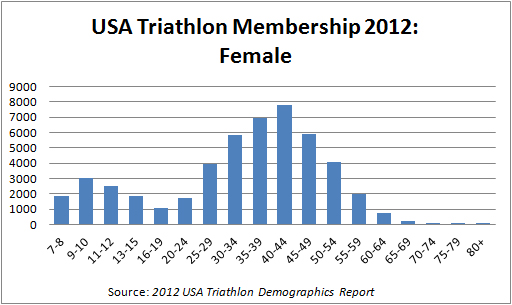
Age groups are of great significance in triathlon. More so than any other event in which I’ve ever participated. When I reviewed age group data for females in triathlon, I found something very interesting. The largest age group for membership in USA Triathlon is 40-44. That fits right in for the perimenopause years. The 45-49 age group is also high, and is very close in number to that for 30-34. I had expected the age groups in the 30s to have higher participation than the 40s.
Triathlon requires an enormous amount of training. It requires both time and intensity. You have to train continually for many months. I’ve participated in Sprint triathlons, so can speak to that. These age group numbers definitely show that females are active throughout their 40s, the main perimenopause years.
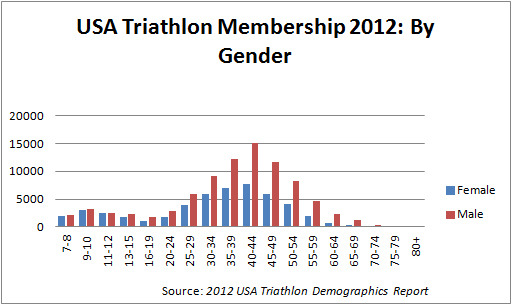
Just for comparison, here is information for both genders. There are more women aged 40-44 than males in the 25-29 age group. It looks like trends are the same. That’s different than what I discovered for running, as you’ll see below.
Running
One large running event came to mind when I thought about checking stats for recreational running. That’s Bloomsday, an annual 12k run in Spokane, WA. To find another, I checked to see what might be in Colorado, as I know the citizens are generally active. Plus, there are recent reports that altitude can make a difference in concussion recovery, so I wanted to check on that. End result: I found Bolder Boulder, a 10k run. The elevation of Spokane is 2,000 feet. The elevation of Boulder is 5,430 feet.
I’ve run in Bloomsday many times, and can tell you that it has quite a range of run levels and can also be very competitive for runners. Much training is required, as it’s a long race and a challenging course. I can see that Bolder Boulder is the same type of race. (It too looks challenging and fun; I just might have to try it some day!) I know that Bloomsday is a major event and much fun; it seems the entire city of Spokane gets involved one way or another. In 2013, there were 51, 613 total participants registered and 47, 298 finished. [3] In Bolder Boulder, in 2012, there were 51,681 entrants and 49,925 finishers. [4] I’ve never run in Bolder Boulder, but by reviewing the website and materials, it looks to me to be the same type of race as Bloomsday: large, long-standing events in their community which have much history and participation. I’m sure many cities have similar races. These are just two, but the data is similar. Perhaps other events in other cities have the same trends.
Female Finisher Percentages
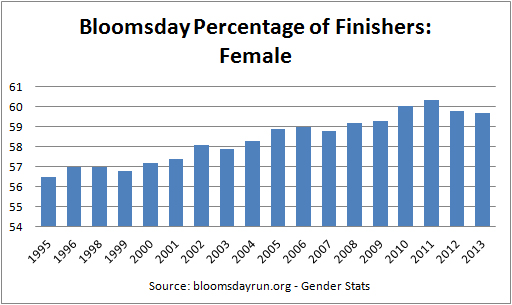
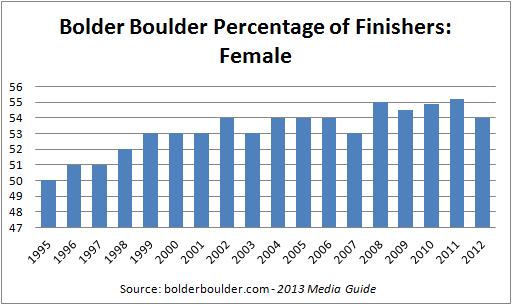
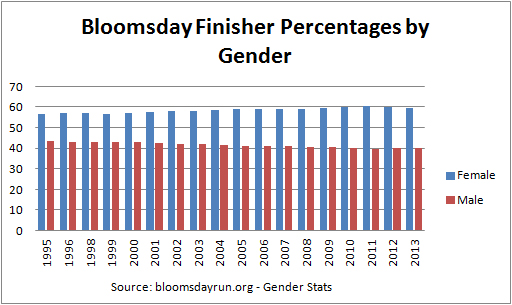
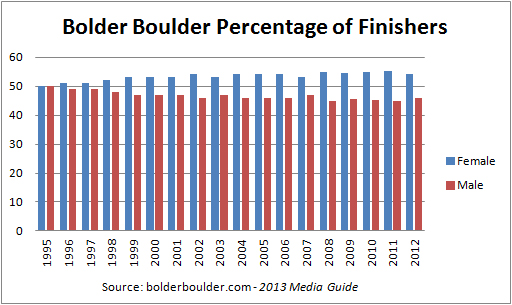
The following two charts look at the percentage of female finishers. For both races, there are more female finishers than males. That has been the case for all the years listed. For Bloomsday, female percentages first exceeded those for males back in 1986. I could only find records back to 1995 for Bolder Boulder, so used the same dates for each for comparison purposes.
Female and Male Percentages
Now look at this data. It includes information about percentages for both genders in each race. I think they’re similar, which has me wondering about other races, too. Is this a trend? I see female participation as increasing and male participation dropping. I don’t know why that is so, but I do think it shows that women are definitely staying active, and perhaps in greater numbers. I’d be interested to look at more races for comparison and to see if this trend holds, and to see more data to find out more about the numbers of female participants. For now, though, I think this is a good indicator that there are many active women out there who participate in 10k or larger running events. That requires training and dedication.
Marathons
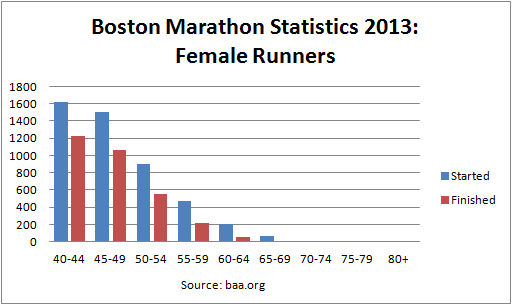
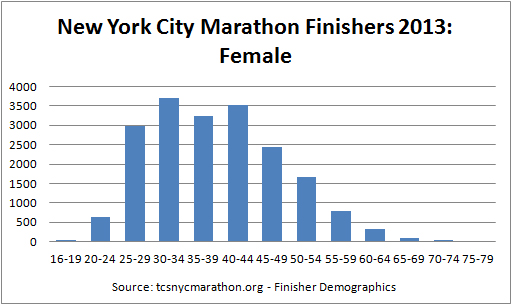
To review statistics for endurance running, I looked at two of the most well-known marathons: Boston and New York City. I found similar results with respect to participation in age groups. In both of these, the 40-44 age group had some of the highest participation. For the Boston Marathon, ages 18-39 were in one group, so I’m unable to get more detail there. That’s why the chart begins with the 40-44 age group.
For the Boston Marathon, 23,342 runners started (both genders) and 17, 600 finished. For females, 9,985 started and 6,951 finished. There was a 69.6% finish rate for females overall. [5] For the New York City marathon, 50,740 runners started (both genders) and 50,266 finished. For females, 19,738 started and 19,567 finished. That’s a 99% completion rate! [6] The charts below show details for female age groups.
There are high percentages of completion for each. I assume that those that didn’t finish ran quite a distance. I’m sure that any marathon runner puts in many hours of training for months beforehand. Here’s an example of suggested mileage for training, all found on the Runner’s World website.
- First-timers Marathon Plan: 25 – 42 miles per week [7]
- Beginners Marathon Plan: 18 – 36 miles per week [8]
- Run Your Best Boston Plan: 24 – 50 miles per week [9]
Also, a study found a high frequency of luteal phase defect (LPD) and anovulation in recreational runners who ran approximately 32.4k (20 miles) per week. [10] So there is some risk of menstrual dysfunction for recreational runners. Running is one of the sports at a higher risk for the Female Athlete Triad.
Perimenopause is a unique life phase with regard to hormones and menstrual cycles. There’s some overlap with the childbearing years as well as the postmenopausal years. I think an important point to keep in mind is that an absence of periods that’s due to concussion or Female Athlete Triad issues may be mistaken for normal perimenopause variations in length of menstrual cycles. It’s something to check on and ask about.
[1] Mitchell ES, Woods NF, Mariella A “Three stages of the menopausal transition from the Seattle Midlife Women’s Health Study: toward a more precise definition” Menopause 2000 Sep-Oct;7(5):334-49
[2] Institute for Optimum Nutrition – Perimenopause ion.ac.uk
[3] Lilac Bloomsday Association Bloomsday Results: General (1977+) bloomsdayrun.org 2014
[4] Bolder Boulder 2013 Media Guide bolderboulder.com 2013
[5] B.A.A Boston Marathon – By the Numbers 2013 Statistics baa.org
[6] TCS New York City Marathon – Finisher Demographics tcsnycitymarathon.org
[7] Runner’s World First Timer’s Marathon Plan (16 weeks) runnersworld.com
[8] Runner’s World Marathon Training Plan for Beginners (16 weeks) runnersworld.com
[9] The Run Your Best Boston Plan from Runner’s World (16 weeks) runnersworld.com
[10] De Souza MJ, Miller BE, Loucks AB, Luciano A, Pescatello C, Campbell G, Lasley BL “High Frequency of Luteal Phase Deficiency and Anovulation in Recreational Women Runners: Blunted Elevation in Follicle-Stimulating Hormone Observed during Luteal-Follicular Transition” Journal of Clinical Endocrinology and Metabolism Volume 83 Issue 12 | December 1, 1998