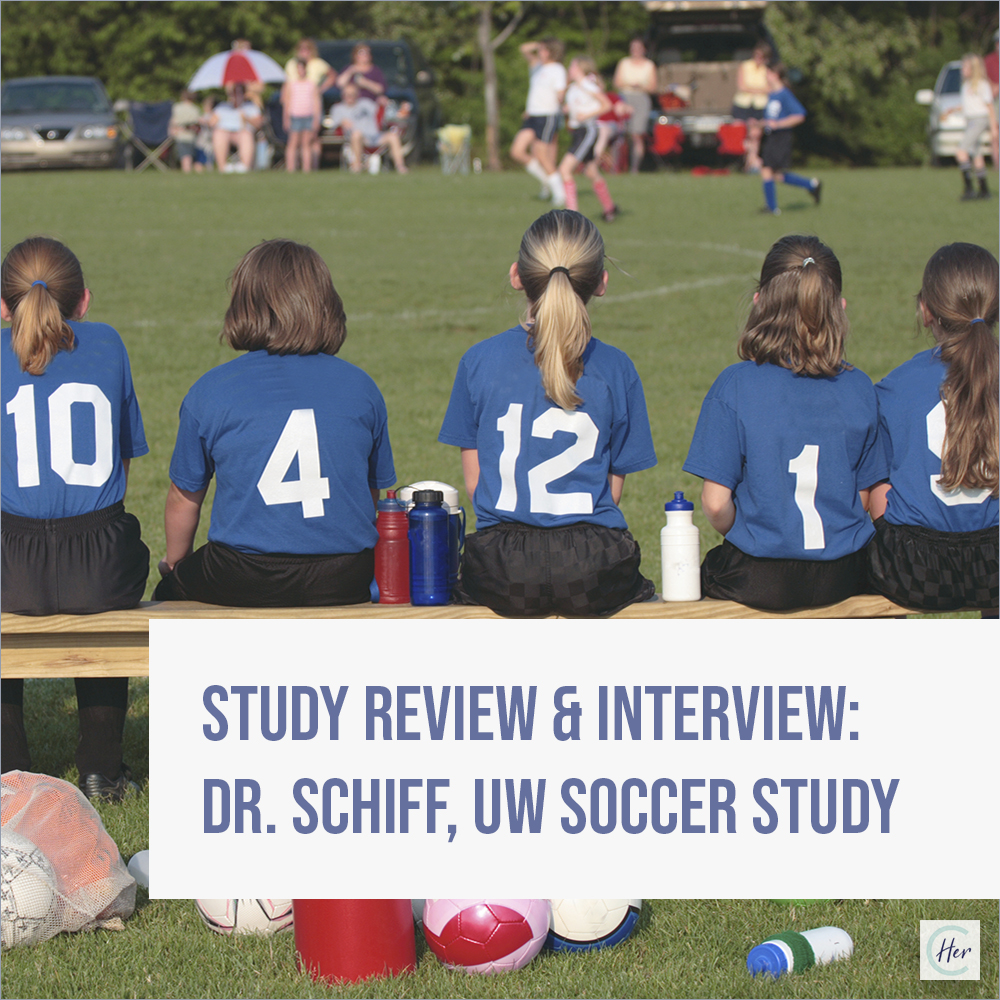
 That there’s a lack of research regarding female concussions is a given at this point. What’s not known as well is that there’s a particular age group which has been largely ignored within the broader female category. It’s the middle-school years. Puberty: the life stage in which some aspects of development occur which affect your entire life one way or another.
Luckily for all of us, a group of researchers at the University of Washington had the foresight to study girls aged 11-14 who play soccer. They did so over a period of four years. Luckily for all of us, a high percentage of girls elected to participate in the study. I say “luckily” because the results of the study show what I consider to be surprising results and tendencies with regard to playing with and reporting concussions.
It’s a pivotal study released at the most opportune time. Over the past year, soccer concussions for females have been in the news more than any other female sport. It’s the most visible sport, the one most recognized, the one discussed the most. Soccer for females also has a high rate of concussion compared to other sports.
So you have concussion information for an important subgroup (puberty years) within a large overlooked group (females) with a high percentage of participants over an extended period (good data, IMO) for a sport recognized as one of the highest for female concussions. It doesn’t get much better than that.
In my opinion, the results of this study warrant serious consideration by soccer coaches, parents, players, educators, and medical professionals. I’ll list some of the results below. Then I’ll share information from a discussion about the study that I had recently with Dr. Melissa Schiff of the University of Washington, one of the researchers.
Study Information and Notable Findings
These are some of the study findings, but certainly not all. Additional details are available through the link below. [1]
Study Description
Study: “Concussion Among Female Middle-School Soccer Players” [1]
Research Institution: University of Washington
Researchers: John W. O’Kane MD, Amy Spieker MPH, Marni R. Levy BS, Moni Neradile, MS, Nayak L. Polissar PhD, and Melissa A. Schiff MD, MPH.
Objective: “To evaluate the frequency and duration of concussions in female youth soccer players and to determine if concussions result in stopping play and seeking medical care”
Study Criteria and Components
- Prospective cohort four-year study (March 2008 to May 2012)
- Ages: 11-14
- 351 elite girls soccer players
- 33 of 36 teams contacted participated (91.7%)
- 351 of 422 players contacted participated (83.1%)
Notable Findings
- 59 concussions
- Eight repeated concussions
- Median recovery time: four days
- Average (mean) recovery time: nine days
- 53% of the girls who were concussed during the season had a previous concussion
- 42% of the girls who did not have a concussion during the season had a previous concussion
- Heading was a cause or factor for 30.5% of the concussions
- Contact with other players was a cause or factor for 54.3% of the concussions
- 58.6% continued to play with concussion
- 44.1% sought medical assistance
- There were more concussions during games than in practices
- Main symptoms resulting in longer recovery times (in order): light sensitivity, emotional lability, noise sensitivity, memory loss, nausea, and concentration issues
I talked to Dr. Melissa A. Schiff about the study, as I had some questions and consider the findings to be important. Excerpts from that conversation follow.
Age Group
I was thrilled to see this study, as it focused on this specific age range. In my research for hormones and concussion, I’ve seen just how critical this age is and that there just isn’t much, if any, information available. I asked Dr. Schiff why the researchers worked with this age group.
Dr. Schiff: “The reason we worked in this age group is that there are really, as you know Julie, are very little data on concussions in middle-school aged players. So that was one of our big motivations for looking at this age group. The other is that many of the studies of concussion have been done for football players because they probably have the highest risk of any of the sports. And, since girls are not playing football then it’s hard to find information on females. That’s why we looked at soccer. There’s kind of similar play between males and females.”
Previous Concussion Percentages
The rate of previous concussion found in this study is notable. It’s recognized that if you’ve had one concussion, it can affect recovery times for concussions you may have afterward and may increase risk of future concussion.[2] [3] They add up. This, to me, seems a very young age at which to have one concussion, let alone several. These are important developmental years – not just for many physical characteristics, but for the brain itself. [4] [5]
As I reviewed the report, one item in particular intrigued me. The report states “A nonsignificant considerable portion of players reported a previous soccer-related concussion.“ I asked for details regarding significance in this finding.
Dr. Schiff: “If you look in our Table 1 of the paper, 53% of the girls who were concussed had a concussion before.” She stated, “Of those who were not concussed during the season, 42% of those reported a prior concussion. So when you do statistics of those comparisons they’re not significantly different.
But still, 53 or 42% is a significant number of people. It’s close to half of them. Not one in 10 or one in 20 or something like that.”
Types of Injuries
Admittedly, I don’t know much yet about soccer (although I’m learning). When I first started looking into soccer concussion injuries, I assumed that most occurred due to heading. I was surprised to learn that there are often collisions between players when they go to head the ball. Injuries are not necessarily from heading the ball, but for an activity in the process of doing so. I think it’s important to keep that in mind when reviewing studies and other information. I’ve read that some injuries also result from unintentional injuries in the course of play, such as getting kicked or struck with an elbow. This study, thankfully, looked at different types of injuries.
The study results indicated that 54.3% of injuries were due to contact with other players. Contact with the ball was 29.8%. Contact with the playing surface was 15.9%.
Because 54.3% of the injuries were due to contact with other players, I was curious about what kinds of contact.
Dr. Schiff: “We didn’t specify what was hit with what. It could be a head to head. It could be an elbow to a head. It could be any body part to another body part of the other player.”
Further details were beyond the scope of the study. However, these comments indicate the types of injuries that may occur for soccer, which is helpful to know. I think it’s something that coaches and parents could watch for.
Playing with Symptoms
I do believe that people sometimes think that girls aren’t as serious when it comes to sports. I think that nothing could be further from the truth, actually. Females are competitive and driven to succeed just as much as males. This study included girls from elite teams. Therefore, on one hand, it wasn’t completely suprising to me to see this finding:
58% of study participants continued to play with symptoms.
On the other hand, I found this percentage to be quite high. 58%. I wondered why this might be the case. Why did they play through symptoms? Were they trying to be tough and “shake it off” or for some other reason in particular? Were they unfamiliar with concussion symptoms and the need for rest and recovery? Are coaches and parents knowledgeable about concussion symptoms? The study didn’t go to that level of detail for this aspect. However, one of the conclusions is that there isn’t enough awareness of the symptoms. This is something with which I agree. I believe it’s necessary to ensure that people know the issues and symptoms to perhaps help reduce this percentage.
Light and Noise Sensitivity Symptoms
Some results I find notable are that light and noise sensitivity are two of the top three symptoms that resulted in longer recovery periods for concussees vs. those without concussions.
Light sensitivity symptoms lasted 16.0 days vs. 3.0 days. Noise sensitivity symptoms lasted 12.0 vs 3.0 days.
Light and noise sensitivity are common to headaches, migraines in particular. Headaches and migraines are common symptoms of concussion for females. Migraines sometimes occur at specific times in the menstrual cycle, which is something I’ve also been researching with regard to concussion. So those two findings really jumped out at me. With all that in mind, I asked if it was surprising to researchers to find light and noise sensitivity high on the list of symptoms that extended for longer periods of time.
Dr. Schiff: They weren’t the most common but they were definitely some that were reported by our girls. So I can’t say that it was surprising. We were expecting to find a whole range of symptoms from our girls.”
Julie: But those seemed to have longer time periods. Or that they had those symptoms longer than perhaps some of the others.
Dr. Schiff: Right.
Overall Recovery Times
The median recovery time was four days. The mean (average) recovery time was nine days. In providing more detail, Dr. Schiff stated:
Dr. Schiff: “There were a couple of girls that experienced symptoms for a long period of time. So that will make the mean – the average – look a little bit longer. The median was four days. Half of the girls experienced symptoms for four or more days and half for less than four days.”
I asked what the longest duration of recovery was.
Dr. Schiff: “I think that one of our subjects was probably out for about somewhere in the neighborhood of two months. That was the longest range from what I recall.”
Summary
This is an excellent study. We’re lucky to have it. The results identify a need for action. Now that it’s been released, it’s time to share the results and make some changes. In my mind, this is what’s needed:
- Education for parents, coaches, educators, and girls about concussion symptoms for this age group
- A change in culture, just like in football and other sports: it’s not just “getting your bell rung”
- Emphasis on the importance of not playing if an injury occurs: when in doubt, sit out!
Study Conclusions
Here are the conclusions from the report.
“Concussion rates in young female soccer players are greater than those reported in older age groups, and most of those concussed report playing with symptoms. Heading the ball is a frequent precipitating event. Awareness of recommendations to not play and seek medical attention is lacking for this age group.” [1]
In a followup, Dr. Schiff provided more information about the study findings.
Dr. Schiff: “We were not aware of any adverse outcomes from the concussions in the short run, although we did not evaluate this specifically.”
Notes
In closing, I’d like thank the researchers (noted above) for focusing on girls in general and in this age group in particular. There’s not much known yet, and this study definitely helps. Thanks, too, to Dr. Schiff for fitting this in to your schedule.
Concussion Information
With all this discussion about increasing awareness and education, I thought I’d provide a link for you. The CDC has a good section about concussion. They update it continually. If you’d like more information about concussion, particularly with youth sports, this is a great place to start:
CDC Heads Up: Concussion in Youth Sports
Related Post
Menstrual Cycles: Puberty and Mid-Adolescence
[1] O’Kane J, Spieker A, Levy M, Neradilek M, Polissar N, Schiff M. “Concussion Among Female Middle School Soccer Players“ JAMA Pediatrics January 2014
[2] Mild TBI and Concussion cdc.gov
[3] Concussion Risk Factors mayoclinic.org
[4] The Teen Brain: 7 Things to Know nimh.nih.gov
[5] Lenroot RK et al, “Sexual dimorphism of brain developmental trajectories during childhood and adolescence” Neuroimage 2007
Copyright 2015 Tailored Thoughts. All rights reserved. This content cannot be republished, reprinted, or used without permission. For content questions, send me a note via the Contact form.