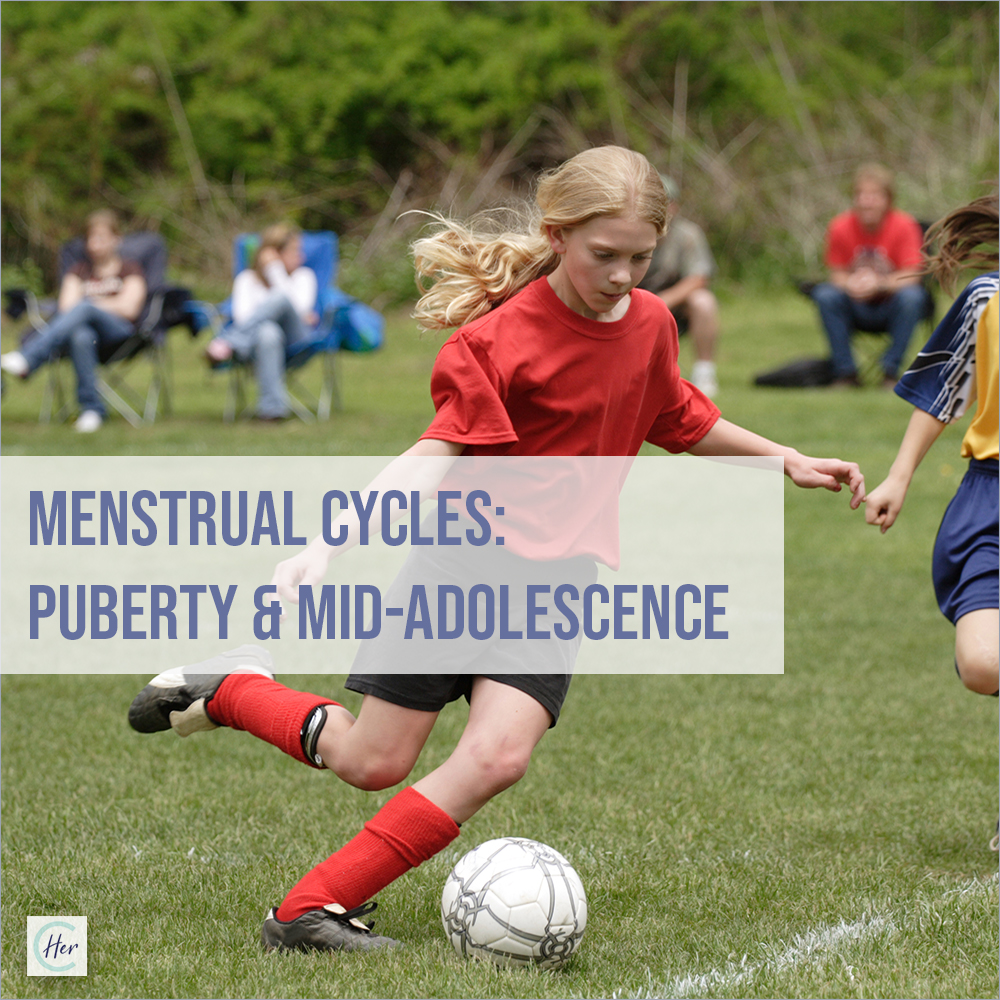
 Menstrual cycles vary due to the phase of life. Periods during puberty are different than those in other phases, and overall reproductive functioning is still in development.
Note: Many of the facts in the following two sections come from an article in Pediatrics. [2]
Cycle Characteristics
| Age range | 11 – 14 (puberty); 15 – 17 (mid-adolescence) [1] |
| Cycle duration | 21 – 45 days, except after the first period |
| Cycle characteristics | It’s more difficult to define “regular” periods as they’re not yet regular. This is especially true in the first year (first gynecological year). |
| Early periods | Characterized by some anovulatory cycles (no ovulation) |
| Potential issues | Primary amenorrhea and Female Athlete Triad |
Menarche
| Definition | The first menstrual cycle |
| Average age | 12 – 13. May vary per country and other factors. |
| First period | Generally a light flow. Lasts 2- 7 days. |
| First cycle after menarche | 34 days |
Primary Amenorrhea
Amenorrhea means that a period has not occurred. There are two basic categories: primary and secondary.
Primary amenorrhea means that menarche has not occurred by the age of 16. It is unique to this phase of life.
Secondary amenorrhea, conversely, can occur at other times in one’s life. Secondary amenorrhea occurs when there is no period for 3-6 months. There are two types of secondary amenorrhea: athletic and hypothalamic. Athletic amenorrhea may occur from excessive exercise and the Female Athlete Triad. Hypothalamic amenorrhea could be caused by a TBI.
Ovulation and Menarche
It can take time for ovulation to occur regularly in menstrual cycles (to become ovulatory). It depends on the age at which menarche occurs. If it occurs before age 12, 50% of cycles are ovulatory in the first year after menarche. With later-onset menarche, it may take 8 – 12 years to become fully ovulatory. [2]
Some studies focus on childbearing years while others focus on menopause. I think it’s important to focus on puberty as well, as what occurs then can impact the childbearing years. For instance, if sports participation results in a later menarche due to primary amenorrhea and regular ovulation is negatively impacted for potentially 8-12 years, I wonder if that might perhaps affect fertility during the childbearing years. Also, when there is no ovulation, no progesterone is produced. While more evidence indicated that progesterone levels can help recovery [3] it was subsequently found to have no difference in recovery from acute concussion. [11] Progesterone levels may also indicate the likelihood of protracted recovery times [4].
Soccer Heading and Primary Amenorrhea
A recently-released four-year study of girls soccer players ages 11-14 found that there were concussions that were often related to heading. [5] Of 361 players, there were 59 concussions. The study tracked a variety of symptoms and found higher incidences of light and noise sensitivity, cognitive issues, and more.
As far as I am aware, menstrual cycles and amenorrhea are not generally tracked as concussion symptoms. They’re not usually included in any list of symptoms you find anywhere. At this point, I think it would be helpful to track cycles to see if primary amenorrhea may occur in part due to pituitary issues. For some, is primary amenorrhea actually hypothalamic amenorrhea due to a concussion?
My takeaway: I would prohibit heading of any kind in girls under the age of 12 at the very least and perhaps through the age of 16. There had been recent recommendations calling for a ban under the age of 14. [6] In 2015, U.S. Soccer banned heading for children under the age of 10 and limited heading during practice for those ages 11-13. [9] If a girl has not had her first period by age 16, it’s considered primary amenorrhea. Since this is a possibility for girls who participate in sports, I think that the heading ban for females should extend through age 16. Individually, I don’t think any girl should even consider heading until she has begun menstruating regularly and is in her second gynecological year. That’s just my opinion based on the research I’ve done – and remember that I’m a writer, not a physician. It’s up to the medical community to make such a determination.
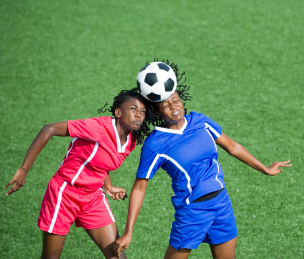
If heading the ball (or colliding with other players in the process of doing so) may impact the pituitary such that it results in late menarche and therefore affects regular ovulation and progesterone production, it seems to me to be too high a risk. Does this occur? I don’t know. It might not. Has it been studied? I can’t yet find a study that focuses specifically on this. Until more is known, I’m glad to see the ban on heading. It’s also not always just heading the ball that causes injury, it’s collisions between two players attempting to head the ball. It seems that removing heading would lessen the frequency and numbers of collisions.
One other aspect about this age group is the timeline for brain development, gray matter in particular. I found a study that describes growth patterns and ages, and found that girls have more gray matter developed in puberty, earlier than males. [7] Then a study just came out that looks at white matter and gray matter and how they can be mapped and reviewed. [8] I think these should be reviewed carefully, especially with regard to soccer heading. Does heading affect this development? What risks (if any) do sports pose?
Tracking Menstrual Cycles During Puberty
One of the questions females hear at medical appointments is the following: when was your last period? It’s a standard, basic question. The question itself varies through the years and through life phases. I’m not sure if there are many variations for puberty. Because periods aren’t yet regular and athletes have unique considerations regarding abnormal menstrual cycles, and because of the long-term issues that could result, this becomes an important question.
“By including an evaluation of the menstrual cycle as an additional vital sign, clinicians reinforce its importance in assessing overall health status for both patients and parents. Just as abnormal blood pressure, heart rate, or respiratory rate may be key to the diagnosis of potentially serious health conditions, identification of abnormal menstrual patterns through adolescence may permit early identification of potential health concerns for adulthood.” [2]
One such potential issue is bone mass development (BMD) during puberty. During these years, most of the bone mass is developed. Primary amenorrhea for a young athlete during puberty may indicate Female Athlete Triad issues. If a girl has triad issues, she could have irreversible bone loss. Low levels of estrogen are a cause of this. [10] I believe that tracking the menstrual cycle during puberty and mid-adolescence is very important, particularly for girls active in sport.
If a girl has any form of hypopituitarism, hypothalamic (primary) amenorrhea, or some other endocrine issue resulting from a concussion or other brain injury, perhaps those may affect proper release of the hormones that result in ovulation (the pulse mechanism). That in turn could result in other issues later on in life.
A lack of periods is not normal, even for athletes. People may hear that athletes don’t have periods as often (often a true statement) but I’ve seen multiple statements indicating that it is not normal to have a lack of periods for timeframes extending beyond three months. It’s important to ask about this.
[1] Stages of Adolescence healthychildren.org (American Academy of Pediatrics) Updated: August 2013
[2] American Academy of Pediatrics “Menstruation in Girls and Adolescents: Using the Menstrual Cycle as a Vital Sign” Pediatrics 2006;118;2245
[3] Healing Hormone Provides Hope for Brain Injury emory.edu April 22, 2013
[4] Wunderle K, Hoeger K, Wasserman E, Bazarian J “Menstrual Phase as Predictor of Outcome After Mild Traumatic Brain Injury in Women” Journal of Head Trauma Rehabilitation
[5] O’Kane J, Spieker A, Levy M, Neradilek M, Polissar N, Schiff M. “Concussion Among Female Middle School Soccer Players “ JAMA Pediatrics January 2014
[6] Parents Vigilance Can Head Off Kids’ Concussion Risk usatoday.com September 29, 2012
[7] Lenroot R, et al. Sexual Dimorphism of Brain Developmental Trajectories During Childhood and Adolescence Elsevier Inc. 2007
[8] “How our brain networks: Research reveals white matter “scaffold” of human brain” usc.edu February 11, 2014
[9] “U.S. Soccer, Resolving Lawsuit, Will Limit Headers for Youth Players” nytimes.com November 9, 2015
[10] DeSouza MJ, Nattiv A, Joy E, Misra M, Williams N, Mallinson R, Gibbs J, Olmsted M, Goolsby M, Matheson G “2014 Female Athlete Triad Coalition Consensus Statement on Treatment and Return to Play of the Female Athlete Triad: 1st International Conference Held in San Francisco, CA, May 2012, and 2nd International Conference Held in Indianapolis, IN, May 2013 Clinical” Journal of Sport Medicine Volume 24, Number 2, March 2014
[11] “Very Early Administration of Progesterone for Acute Traumatic Brain Injury” David W. Wright, M.D. et al, The New England Journal of Medicine, N Engl J Med 2014; 371:2457-2466, December 25, 2014.